Career Inquiry: Career Growth in Medical Education
- hollyables
- Apr 5, 2017
- 3 min read
I have been in medical education for over a decade, but I am not clinically trained. Something of personal interest and frustration to me as an administrator of medical academic programs, is the lack of job growth to those in my career field. The career trajectory is rather short and needs to be changed in order to foster longevity and sustainability of dedicated, accreditation experts who keep the programs running.
This is a topic that is being discussed at national meetings; in fact, it was just discussed at the Accreditation Council of Graduate Medical Education 2018 Annual Education Conference held in Orlando, Florida last week that I attended. While the presenters didn’t demonstrate how to fix the problem, all three of them started out as clerkship (medical student course) coordinators or residency coordinators and advanced to other positions within medical education. Their biggest message to the audience was to get a higher education degree if we don’t already have one (in fact, the main presenter who was the Director of Graduate Medical Education at University of Virginia, was in the process of getting her MS degree - sound familiar?). Since this is an area of career interest to me, I decided to focus this research project on looking at the available jobs in the area of academic medicine and the potential future jobs as one works their way up the career path.
Entry Level: Clerkship Coordinator
I first fell into medical education by accident; my husband started his PhD studies at Vanderbilt University, so I applied for several jobs on-campus since we shared a car and it made sense to be close. I had just been an Events Coordinator at a graduate school outside of Chicago so applying to an academic institution was a no-brainer; however, I had no medical education experience. This didn’t matter as it turned out to be an entry level position and I started as a Clerkship Coordinator in Internal Medicine right away.
Using LinkedIn for my job scan, I found that Clerkship Coordinators (“medical training coordinator,” “medical education coordinator,” etc.) are somewhat entry-level positions, though in my case I had already done administrative assistant work and events coordination at a graduate school admissions office.

Entry/Mid-Level: Program Coordinator
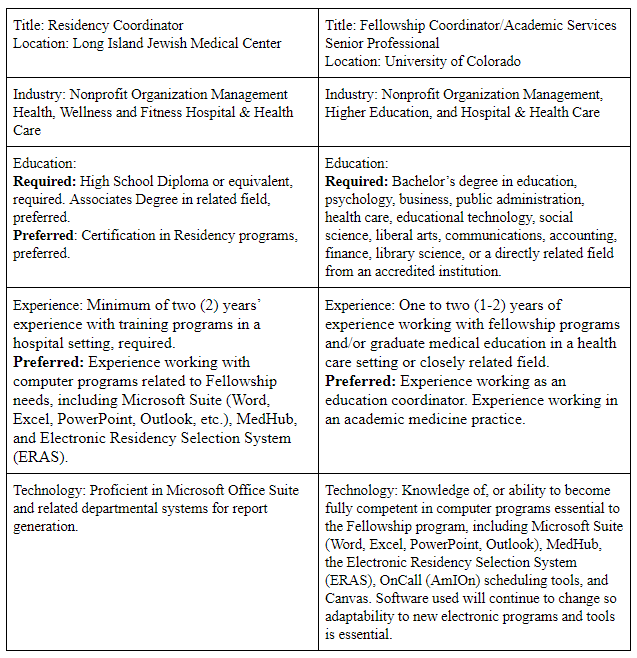
Most people tend to move from Undergraduate Medical Education (UME) which is medical students to Residency or Fellowship, which is housed in the Graduate Medical Education (GME) realm. The rules are different, with more complex accreditation policies, and there are higher stakes with these physicians-in-training. I went from Clerkship Coordinator to an Educational Specialist at Vanderbilt and then to a Fellowship Coordinator at the University of Colorado. Interestingly, when looking at LinkedIn these positions are still listed as entry level.
Mid-Senior Level: Program Manager
After this job title, I was promoted to my current position: Academic Program Manager. At my employer, this job title is rare (I’m one of three on-campus). LinkedIn generally lists this title as a mid-senior level job as it typically involves more involved management of accreditation compliance, programs, and finances.

Senior Level: What’s Next?
The mid-senior level seems to be the top of the career pathway and where I find myself after being in the field for over 10 years. The presenters at the ACGME conference I mentioned had the following titles at the University of Virginia:
Director, GME Office
Director, Education
Education Manager
My current position is essentially the equivalent to the Education Manager, so now I must look towards the Director roles as my next advancement. This is not a direct path that is commonly taken by someone who starts out as an education coordinator, but if I want job satisfaction and promotion, I have to be willing to work hard towards the Director goal. Some of these positions I have seen require a PhD, which I don’t have a desire to do at the moment, but with my years of experience and my MA in hand soon, perhaps this will be attainable.
Further Reading
Williams, R. (July 18, 2016) Navigating the Ship: The Role of Program Coordinators in Graduate Medical Education. American Gastroenterological Association. Retrieved from
http://www.gastro.org/news_items/the-role-of-program-coordinators-in-graduate-medical-education
This article, written by a Program Coordinator at Mayo Clinic, points out the issues surrounding the often enigmatic and unsupported role of Program Coordinators.
Bracken, S., et al. (2018, March 5) Program Coordinator Burnout: Building Support and Job Satisfaction through GME. Retrieved from
https://medicine.utah.edu/gme/coordinators/files/acgme-poster.pdf
This poster studies the importance of Program Coordinator burnout and job satisfaction.
LinkedIn job search links:
Medical Clerkship Coordinator at Johns Hopkins. (2018, March 5) Retrieved from
https://www.linkedin.com/jobs/view/615492717/
Medical Education Coordinator at Stanford. (2018, March 5) Retrieved from
https://www.linkedin.com/jobs/view/615887611/
Residency Coordinator at Long Island Jewish. (2018, March 5) Retrieved from
https://www.linkedin.com/jobs/view/606837917/
Fellowship Coordinator at University of Colorado. (2018, March 5) Retrieved from
https://www.linkedin.com/jobs/view/549424496/
Academic Program Manager at University of Michigan. (2018, March 5) Retrieved from
https://www.linkedin.com/jobs/view/616791976/
Program Manager, Microbiology. (2018, March 5) Retrieved from
https://www.linkedin.com/jobs/view/615418138/

Comments